Explore London England Scotland Wales About API
Southwark · SE5

Camberwell Green

Once a village fairground rivalling Greenwich’s, now a formal park around the healing well that gave Camberwell its name.

Name Meaning
Well of the Britons
First Recorded
1086
Borough
Southwark
Character
Village Common
Last Updated
Time Walk

From Ancient Spring to Modern Park

Camberwell Green is now a hectare (2.5 acres) of common land in Camberwell, south London laid out as a formal park. At its centre stands a modest green, enclosed by a parade of shops including banks and restaurants, with the former Camberwell Magistrate's Court nearby. The crossroads here form the heart of the district—a quiet junction where you can imagine the chaos of a medieval fair or the tranquillity of a rural village green.

2016
Wide resurfaced path, Camberwell Green
Wikimedia Commons · CC BY-SA 2.0
c. ?
Camberwell Green
Camberwell Green
Wikimedia Commons · CC BY-SA 2.0
Historical image not found
Today
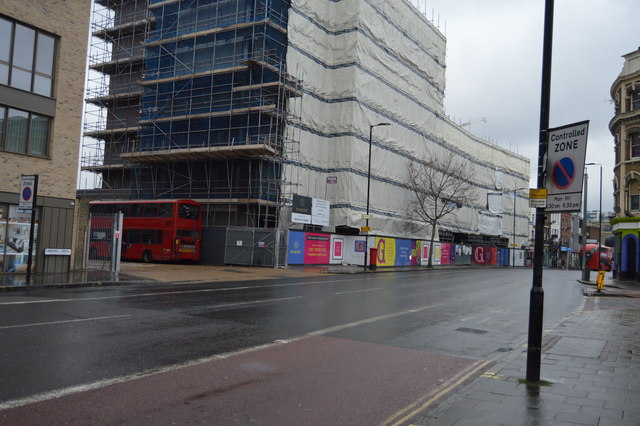
A215, Camberwell — near Camberwell Green
Geograph · CC BY-SA 2.0

Camberwell Green was once a traditional village green on which was held an annual fair, but the name tells an older story. That name came long before the fair, or the park, or even the modern buildings. It arrived with the Anglo-Saxons and the source that gave them reason to settle here.

✦   ✦   ✦
Name Origin

The Well that Named a Settlement

Camberwell appears in the Domesday Book as Cambrewelle. The name may derive from the Old English Cumberwell or Comberwell, meaning ‘Well of the Britons’, referring to remaining Celtic inhabitants of an area dominated by Anglo-Saxons. The Saxon settlers were not alone here. In the centuries after their arrival, pockets of the older British population persisted—and their presence was marked in the place-name itself.

Yet the name may also carry another meaning. As the old British word cam signifies “crooked,” Camberwell may simply mean “the well of the crooked”, possibly referring to those who came seeking healing from the legendary mineral springs. There are mineral springs at Dulwich, Norwood (the Beulah Spa is memorable), and other places in the neighbourhood, and three ancient wells were discovered in a field in the parish, though they were soon covered in again. The Camberwell name refers to the Camber Well, which was said to be rich in mineral salts and iron, thus helping with ailments. The church dedication to St Giles, estimated to have been built in the 7th century AD, suggests that medicinal waters and pilgrimage were central to Camberwell’s early identity. St Giles is the patron saint of the crippled and afflicted—a fitting choice for a place where healing waters flowed.

How the name evolved
1086 Cambrewelle
12th–17th c. Camerwell, Cambwell, Kamwell
18th c. Camberwell
present Camberwell Green
✦   ✦   ✦
History

From Village Fair to Metropolitan Borough

Camberwell was a settlement with a parish church when mentioned in the Domesday Book, and would remain a village of significant standing for centuries. The Green itself became the focal point of the community’s life. The earliest record of the fair is in 1279, and the spot was in bygone times the scene of an annual fair, almost rivalling in riotousness that at Greenwich. The fair was appointed to be held on the 9th of August, and to terminate on the 1st of September—the feast of St. Giles, the patron saint; thus it must have lasted for twenty-three days. Such occasions drew crowds for weeks.

Key Dates
1086
Domesday Record
Cambrewelle recorded as a settlement with church; held by Haimo the Sheriff of Kent.
1279
Fair Established
Earliest recorded mention of Camberwell Fair on the Green.
1811
Green Enclosed
Camberwell Green was enclosed by rails to protect it from development.
1842
Mendelssohn's Inspiration
Composer Felix Mendelssohn stayed in Camberwell and wrote ‘Camberwell Green’, now known as ‘Spring Song’.
1855
Fair Abolished
The annual Camberwell Fair was suppressed as it had begun to attract ‘undesirables’.
1860s
Railway Transformation
Arrival of railways changed the rural landscape, bringing urban development to the district.
1900
Metropolitan Borough
Camberwell became a metropolitan borough; Green purchased by Vestry to protect from development.
Did You Know?

In 1842, composer Felix Mendelssohn was inspired to write “Camberwell Green”, now better known as “Spring Song”—a piano piece that outlived the fair it was named after by over a century.

Up until the nineteenth century, Camberwell remained a rural village. Up to the mid-19th century, Camberwell was visited by Londoners for its rural tranquillity and the reputed healing properties of its mineral springs. But Camberwell was changed by the arrival of the railways in the 1860s. The fair itself did not survive modernisation; it was abolished in 1855 as by this time it “attracted too many undesirables”. The Green was bought by Camberwell Parish Vestry in the late 19th century to protect it from development, securing it as public land when speculative building threatened to absorb it entirely. What had been a common of medieval fairs became a Victorian park, and later a neighbourhood landmark.

✦   ✦   ✦
Street Origin Products

Your listing has a better story than it’s telling

Camberwell Green has 700 years of documented history—from a medieval healing sanctuary to a Victorian fair. Here’s how to put it to work.

Professional Edition
Street Pack
“Why this address matters.”

Buyers pay more for addresses with a story. The Street Pack gives estate agents and developers brochure-ready copy, prestige framing and a name origin panel—everything needed to make this address feel significant before a viewing is booked.

  • Brochure copy — 100 & 200 word versions
  • Prestige framing version
  • Name origin panel
  • Timeline strip
  • Buyer persona framing
For estate agents, developers & property portals
From £19
Get the Street Pack
Street Social Kit
“Why this place feels interesting.”

Airbnb guests choose atmosphere as much as amenities. The Social Kit gives you five ready-to-post tiles, story templates, captions, hooks and a Reel script—all built from this street’s actual history. Done for you, in minutes.

  • 5 ready-to-post social tiles
  • 3 Story templates
  • 5 captions & 3 hooks
  • 1 Reel script
  • Hashtag clusters
For Airbnb hosts, boutique landlords & small agents
From £9
Get the Social Kit
✦   ✦   ✦
Culture

Music and Memory on the Green

The “Father Redcap” (1853) still stands by Camberwell Green, but internally, much altered. This public house, one of the earliest music halls in the district, testifies to Camberwell’s emergence as an entertainment destination in the nineteenth century. The cultural memory of the place endures beyond its buildings. In 1842 the composer Felix Mendelssohn stayed with his wife’s relatives at Camberwell and was inspired to write “Camberwell Green”, now better known as “Spring Song”—a piece that has outlasted the fair that inspired it.

Cultural Legacy
Mendelssohn’s Spring Song

The most enduring memorial to Camberwell Green is not a building but a musical composition. Mendelssohn’s “Camberwell Green” (Op. 62, No. 6), officially titled “Allegretto grazioso in A major,” became one of his most beloved Songs Without Words. It remains the only major work of art named after the site.

The Camberwell beauty is a butterfly (Nymphalis antiopa) which is rarely found in the UK–it is so named because two examples were first identified on Coldharbour Lane, Camberwell in 1748. The butterfly, like the fair and Mendelssohn’s piece, carries Camberwell’s name into posterity—each a different mark of the place on human imagination.

✦   ✦   ✦
People

Writers, Thinkers, and Composers

Thomas Hood, humorist and author of “The Song of the Shirt”, lived in Camberwell from 1840 for two years; initially at 8, South Place (now 181, Camberwell New Road). He later moved to 2, Union Row (now 266, High Street). Hood praised the clean air in letters to friends, and his presence here marks Camberwell’s appeal to the educated classes before rapid urbanisation changed its character.

The Victorian art critic and watercolourist John Ruskin lived at 163 Denmark Hill from 1847, but moved out in 1872 as the railways spoiled his view. Ruskin’s residency was brief but consequential—Ruskin Park, one of Camberwell’s most significant green spaces, is named in his honour. His departure also marks a moment in the area’s history: the precise point when Victorian tranquillity gave way to industrial modernity.

✦   ✦   ✦
Recent Times

The Peabody Estate and Modern Regeneration

The design for Camberwell Green won an architectural competition in 1909 and the successful architect, Victor Wilkins, worked on the project which was completed and opened to its first residents in 1911. This was the Peabody Trust, which originated from the gifted funds of philanthropist George Peabody, donated to the benefit of the people of London. The Peabody Estate remains the largest residential presence around the Green, a landmark of early twentieth-century social housing designed to raise living standards for working families.

Today, according to SE1 Direct, Camberwell Green is undergoing gentle regeneration whilst retaining its character as a community hub. The weekly market, the parade of shops and cafés, and the park itself continue to anchor the area’s identity—a living continuation of the Green’s original function as a gathering place for the neighbourhood.

✦   ✦   ✦
Today

A Formal Park at the Crossroads

Standing on Camberwell Green today, you inhabit the heart of a district transformed. The Green itself is now enclosed by iron railings, a formal garden laid out in grass and flowers, no longer the open commons where livestock grazed or thousands gathered for a month-long fair. Yet the functions persist in different forms. The market still runs on Saturdays. The shops, banks, and restaurants still draw crowds. A parade of shops including banks and restaurants overlooks the space, and bus routes radiate from the junction like spokes from a hub.

4 min walk
Ruskin Park
Edwardian Park with a bandstand and formal gardens, one of South London’s most elegant green spaces.
8 min walk
Myatt’s Fields
Historic common land now managed as a public park with mature trees and wild areas.
12 min walk
Burgess Park
Major urban park with lake, sports facilities, and landscaped gardens.
15 min walk
Peckham Rye
Historic common of 54 acres, one of South London’s largest green spaces with woodland walks.

The architectural context is mixed. In 1910 the Peabody estate at Camberwell Green brought the first of many flats, culminating in system-built blocks in the 1960s and 1970s. Modern residential buildings and the former magistrate’s court sit alongside Victorian terraces that survived clearance. As documented by British History Online, Camberwell Green was enclosed by rails in 1811—a decision made centuries ago that still shapes what you see today. The Green remains what it has been for over 200 years: a protected common, now a park, at the centre of a neighbourhood that has continued to live, trade, and gather around it.

✦   ✦   ✦
On the Map

Camberwell Green Then & Now

National Library of Scotland — Ordnance Survey 6-inch, c. 1888. Hosted by MapTiler. Modern: © OpenStreetMap contributors.

✦   ✦   ✦

Frequently Asked Questions

Why is it called Camberwell Green?
The name Camberwell likely derives from Old English meaning “Well of the Britons” or possibly “Crooked Well,” referring either to Celtic inhabitants or to healing springs in the area. The “Green” refers to the common land itself—the village green around which the medieval community gathered. St Giles church, dedicated to the patron saint of the afflicted, reinforces the connection to healing waters.
When was the Camberwell Fair held, and why was it abolished?
The fair was first recorded in 1279 and ran for centuries, most famously lasting from 9 August to 1 September (the feast of St Giles). By the 18th and 19th centuries it ran in mid-August for three days. It was abolished in 1855 because authorities deemed it attracted “undesirables.” The fair had become disreputable, and the enclosure of the Green and urban development made its continuation impossible.
What is Camberwell Green known for today?
Camberwell Green today is known as a formal park at the centre of the district, where a weekly market runs on Saturdays. It is surrounded by a mix of Victorian housing, Peabody estate flats, and modern residential buildings. Historically it is celebrated as the former site of a medieval fair rivalling Greenwich’s, and as the place that inspired Felix Mendelssohn to compose “Spring Song,” one of his most beloved piano pieces.