Explore London England Scotland Wales About API
Southwark · SE5

Camberwell Church Street

A thousand years of worship defined this route. The medieval parish church burned and rose again as a Victorian masterpiece, standing sentinel over Camberwell’s transformation.

Name Meaning
Church of Camberwell
First Recorded
7th Century
Borough
Southwark
Last Updated
Time Walk

A Medieval Road Through Transforming Suburbs

The old villages of Camberwell and Peckham were situated on the northern face and at the foot of the slope of the hills, where the old road along the dry side of the Thames Valley, after passing down Coldharbour Lane, is continued as Camberwell Church Street and Peckham Lane to meet the road from Kent at New Cross. Today the street carries heavy traffic past the striking Gothic church and connects Camberwell Green to the north–south arteries of south London. Yet for centuries its primary purpose was humble—a pilgrim route and parish road anchored by one of England’s oldest places of worship.
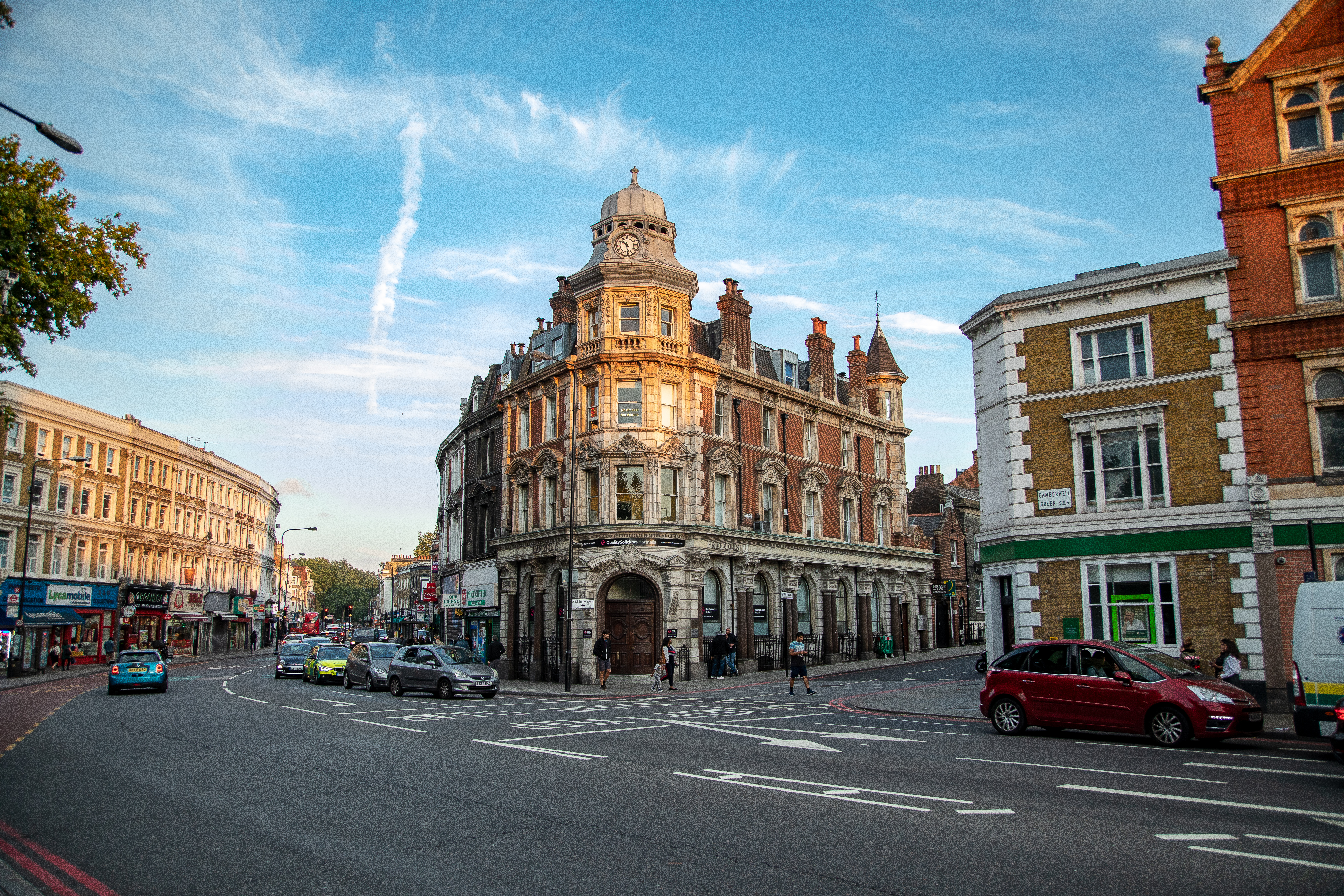
2018
2, Camberwell Church Street
Wikimedia Commons · CC BY-SA 4.0
2024
2 Camberwell Church Street 2024-08-02
Wikimedia Commons · CC BY 2.0
Historical image not found
Today
Camberwell Grove
Camberwell Grove
Geograph · CC BY-SA 2.0

St Giles’ Church dominates the street visually and historically. On 7 February 1841 a devastating fire, caused by a faulty heating system and fuelled by the wooden pews and galleries virtually destroyed the medieval church. The heat was so great that stained glass melted and stone crumbled to powder. What rose in its place would define the street’s character for the next two centuries. The name itself reveals the street’s origins: it was never important for commerce or industry, but for the church that gave it identity.

✦   ✦   ✦
Name Origin

A Street Named for Faith

Camberwell Church Street takes its name directly from its most prominent landmark: the parish church of St Giles. St Giles’ Church, Camberwell, is the parish church of Camberwell, a district of London which forms part of the London Borough of Southwark. The street designation simply identifies the principal road running past the church, which has occupied this site for over a thousand years. There has been a church on this site for at least a thousand years. The Saxon church, probably of wood, was rebuilt in stone in 1152 by William of Gloucester, Lord of the Manor. The wider district of Camberwell itself carries an older, more enigmatic name, whose exact origin remains disputed among etymologists.

The name ‘Camberwell’ itself suggests a place defined by water. Some etymologists trace the first portion of the name to the British owm hir, long valley; and suppose that the last syllable has reference to some springs of water, at one time famous. Another theory holds that ‘camber’ derives from Old English meaning ‘cripple,’ suggesting a healing well where the afflicted sought relief through the church’s intercession. A local legend associates the dedication of St Giles with a well near Camberwell Grove, which may also have given Camber-well its name. An article on the church from 1827 states: “it has been conjectured that the well might have been famous for some medicinal virtues and might have occasioned the dedication of the church to this patron saint of cripples.” Church Street, by contrast, is transparent: it names the institution around which the medieval parish pivoted.

How the name evolved
7th–12th century Church Lane
13th–18th century Camberwell Church Lane
19th century onwards Camberwell Church Street
✦   ✦   ✦
History

From Saxon Worship to the Age of Scott

The first church of Camberwell is one of the very few of which we have authentic mention in ‘Domesday Book,’ and is considered by some to have dated its erection from within sixty years of the first landing of St. Augustine, or about the middle of the seventh century. In the reign of King Stephen, 1152, the original structure underwent extensive changes, and two years afterwards became subject to the abbey of St. Saviour, Bermondsey, by gift of William de Mellent. For nearly seven centuries, Camberwell Church Street served the parish as the main approach to worship. Medieval pilgrims and worshippers traversed it on foot.

Key Dates
c. 650
Saxon Church
Church of Camberwell first recorded in early Anglo-Saxon sources.
1152
Stone Rebuild
William of Gloucester, Lord of the Manor, rebuilds the church in stone and grants it to Bermondsey Abbey.
1841
Great Fire
Medieval church destroyed by fire on 7 February caused by faulty heating system.
1842–1844
Scott & Moffat Win
Architectural competition for new church won by partnership of Scott and Moffat; design combines Early English Gothic with monumental proportions.
1844
Consecration
St Giles’ Church consecrated on 21 November, becoming an architectural landmark of the Victorian era.
Did You Know?

The Camberwell Samaritans later became the St Giles Trust which continues to operate in Camberwell Church Street, a few minutes walk away from the church. The organisation that grew from the church’s crypt now operates directly on the street itself, continuing a thirteen-hundred-year legacy of parish care.

St Giles, Camberwell was designed by Scott & Moffat in 1842-4. The Camberwell vestry clearly wanted a Gothic design for their new church, so Sir George Gilbert Scott competed and Blore chose him for the work. This competition victory established Scott as a master of Victorian ecclesiastical design. This was to be a large parish church, within a few miles of the centre of London, serving a large and growing population, including many families of the status of the Ruskins, who lived a mile-and-a-quarter away, at Herne Hill. The new church became the focal point of Camberwell’s rapid expansion as suburban railways arrived in the 1860s. Where once medieval pilgrims had walked, Victorian commuters now passed daily. Church Street remained the parish road, but the parish itself had swelled into a densely populated south London neighbourhood.

✦   ✦   ✦
Street Origin Products

Your listing has a better story than it’s telling

Camberwell Church Street sits at the heart of one of south London’s oldest ecclesiastical sites. Here’s how to make that narrative work for you.

Professional Edition
Street Pack
“Why this address matters.”

Buyers pay more for addresses with a story. The Street Pack gives estate agents and developers brochure-ready copy, prestige framing and a name origin panel—everything needed to make this address feel significant before a viewing is booked.

  • Brochure copy — 100 & 200 word versions
  • Prestige framing version
  • Name origin panel
  • Timeline strip
  • Buyer persona framing
For estate agents, developers & property portals
From £19
Get the Street Pack
Street Social Kit
“Why this place feels interesting.”

Airbnb guests choose atmosphere as much as amenities. The Social Kit gives you five ready-to-post tiles, story templates, captions, hooks and a Reel script—all built from this street’s actual history. Done for you, in minutes.

  • 5 ready-to-post social tiles
  • 3 Story templates
  • 5 captions & 3 hooks
  • 1 Reel script
  • Hashtag clusters
For Airbnb hosts, boutique landlords & small agents
From £9
Get the Social Kit
✦   ✦   ✦
Culture

Victorian Gothic at the Heart of a Living Parish

St Giles’ Church dominates Camberwell Church Street not merely as a building but as a statement. St Giles’ was one of the first major Gothic buildings by George Gilbert Scott, best known as architect of St Pancras Station and the Albert Memorial. The church is a work of serious ambition—an Early English Gothic structure with a central tower rising 210 feet, commanding views across south London. The interior combines ecclesiastical drama with craftsmanship: The organ at St Giles’ is a historically significant instrument, designed by Samuel Sebastian Wesley. After the 1841 fire, Wesley returned to St Giles’ to design the new organ in 1844 and played it at the opening recital.

Landmark Church
St Giles’ Church (1844)

The street’s defining structure: a Victorian Gothic parish church designed by one of the era’s greatest architects. The church serves as both a working place of worship and a monument to 1840s ecclesiastical ambition. Its organ, redesigned by Samuel Sebastian Wesley, remains historically significant.

Beyond the church, Camberwell Church Street reflects the layered history of south London. The road itself evolved from a medieval parish lane into a Victorian suburban thoroughfare and today functions as a crucial traffic link. The street’s character is one of institutional gravity: the church, nearby institutions, and the dense housing that followed the railways all cluster along its path. Unlike West End streets that celebrate commerce or Georgian avenues that showcase domestic prestige, Camberwell Church Street derives its identity from faith and community infrastructure.

✦   ✦   ✦
On the Map

Camberwell Church Street Then & Now

National Library of Scotland—Ordnance Survey 6-inch, c. 1888. Hosted by MapTiler. Modern: © OpenStreetMap contributors.

✦   ✦   ✦
Today

A Working Parish in Modern Southwark

Camberwell Church Street today is a busy north–south traffic route, carrying commuters and delivery vehicles between Southwark’s neighbourhoods. The street hosts a mixture of Victorian terraced housing, early twentieth-century commercial blocks, and modern institutional buildings. St Giles’ Church remains visible from considerable distance, its broach spire cutting through the urban skyline. The church itself continues active worship and serves the surrounding communities.

The street carries little trace of its medieval origins, save the church. Modern development has obliterated the wells that gave Camberwell its name and the open fields through which pilgrims once walked. Yet the fundamental character persists: a route defined by institutional and residential use rather than commerce. The St Giles Trust operates from nearby premises, continuing the church’s long tradition of parish relief and social care. Bus routes converge here. The street remains, as it has been for a thousand years, a gathering point and a threshold between different quarters of the city.

12 min walk
Ruskin Park
Victorian landscaped park on Denmark Hill with woodland walks, views across south London, and named after art critic John Ruskin who lived nearby.
14 min walk
Peckham Rye Common
54-acre common with open grassland, mature trees, and historical significance as a traditional village green dating to medieval times.
16 min walk
Camberwell Green
Small remnant of the original village green and fair ground. Historic site now preserved as public space in the heart of the neighbourhood.
18 min walk
Dulwich Park
72-acre Victorian park with ornamental lake, tree-lined avenues, and designed landscapes showcasing 19th-century park design.
✦   ✦   ✦

Frequently Asked Questions

Why is it called Camberwell Church Street?
The street takes its name from St Giles’ Church, the parish church of Camberwell. The church has occupied this site for over a thousand years—first as a Saxon wooden structure, later rebuilt in stone in 1152. Church Street simply identifies the principal road running past this medieval landmark.
What does ‘Camberwell’ actually mean?
The etymology is debated. Most scholars agree the second element, ‘well,’ refers to springs that once existed on Denmark Hill slopes. The first element may derive from Old English meaning ‘cripple’ (suggesting a healing well), or from ‘well of the Britons,’ referring to Celtic inhabitants who remained during the Anglo-Saxon period. A medieval legend linked the name to medicinal waters and the church’s dedication to St Giles, patron saint of the disabled.
What is Camberwell Church Street known for?
The street is known today as a busy traffic artery in south London. Historically, it is defined by St Giles’ Church—a Victorian Gothic masterpiece designed by George Gilbert Scott and completed in 1844, which stands on a site occupied by a church for nearly 1,400 years. The street marks Camberwell’s transformation from a rural village centred on its parish church to a densely populated Victorian suburb.