Explore London England Scotland Wales About API
Southwark · SE15

Peckham Rye

The road that carries an Anglo-Saxon stream in its name — and the common where an eight-year-old William Blake first saw angels in a tree.

Name Meaning
Village-stream
First Recorded
1086 (Domesday)
Borough
Southwark
Character
Common & road
Last Updated
Time Walk

Where the Village Ends and the Common Begins

The triangular common at the end of Rye Lane is the green lung of SE15 — 64 acres of open grassland that developers tried to build on in the 1860s and failed. Today the road called Peckham Rye traces the western and eastern edges of this open space, sheltering terraces of Victorian stock-brick on one side and the park’s ornamental gardens, lake and Japanese garden on the other. The cluster of cafés and restaurants that has gathered at the northern tip of the Rye gives the street its contemporary character: convivial, diverse and unmistakably south London.

2014
Peckham Rye railway station MMB 17 378150
Wikimedia Commons · CC BY-SA 4.0
2017
In Peckham Rye Park
In Peckham Rye Park
Wikimedia Commons · CC BY-SA 2.0
Historical image not found
Today
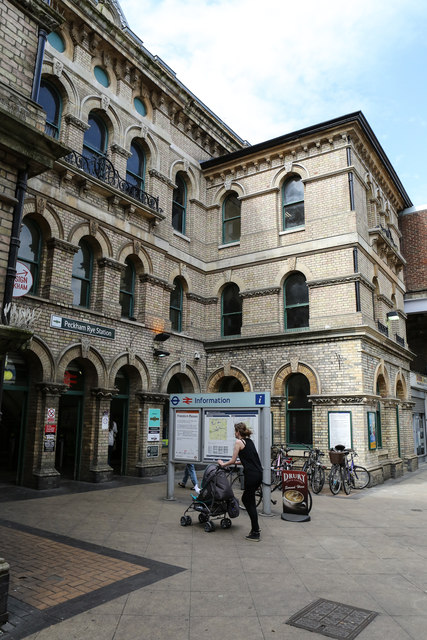
Peckham Rye Station
Peckham Rye Station
Geograph · CC BY-SA 2.0

Walk the full length of the road and you cross from the urban density of Peckham into a landscape that has been common land since 1868. That transition — from terrace to open sky — is as old as the name itself. The word “Rye” tells you what was here before the road: a stream.

✦   ✦   ✦
Name Origin

A Hill Village and Its Forgotten River

The stream hidden in the name is the River Peck. “Peckham Rye” takes its second element from the Old English rīth, meaning ‘stream’. In some old documents the Rye is spelled “Rey;” and the old word “ree,” a water-course, river, or expanse of water, is considered as probably the origin of the term. This is confirmed by British History Online’s edition of Old and New London, the earliest scholarly treatment of the toponym. The River Peck was largely enclosed in 1823, though parts of this stream can still be seen on the west side of Peckham Rye Park today.

The Oxford Dictionary of English Place-names gives the origin of “Peckham” as from the Old English *pēac and hām, meaning ‘homestead by a peak or hill’. The nearby hills are Honor Oak, Forest Hill and Telegraph Hill. Peckham was mentioned in the Domesday Book of 1086, where it is called ‘Pecheha’. Following the Norman Conquest, the manor of Peckham was granted to Odo of Bayeux; it was described as a hamlet on the road from Camberwell to Greenwich. The name Peckham Rye, combining both elements, identifies the stream meadow belonging to that hilltop village.

How the name evolved
1086 Pecheha
c.13th c. Pecheham
early records Peckham Rey
present Peckham Rye
✦   ✦   ✦
History

From Farming Common to Victorian Suburb

Peckham Rye Park is recorded as being cultivated before the Norman Conquest in the 11th century. For most of its early existence the area was agricultural. Maps from the 1740s depict the area as a network of fields and smallholdings, with herds able to graze on the common before heading into the city. Since 1744 stagecoaches had travelled with an armed guard between Peckham and London to give protection from highwaymen.

Key Dates
1086
Domesday Record
Peckham recorded as ‘Pecheha’ in the Domesday Book, held from Odo of Bayeux.
c.1765
Blake’s Vision
The eight-year-old William Blake walks six miles from Soho to the Rye and sees angels in an oak tree.
1823
River Enclosed
The River Peck, which gave the Rye its name, is enclosed underground. A remnant survives in the park.
1865
Railway Arrives
Peckham Rye station opens on 1 December for London, Chatham and Dover Railway services.
1868
Common Saved
Camberwell Vestry purchases the Rye, defeating development plans and securing it as public common land.
1894
Park Opens
Peckham Rye Park declared open on 14 May, after the London County Council paid £51,000 for Homestall Farm.
1940–41
Wartime
78 bombs fall in the Peckham Rye area. Part of the Common becomes a camp for Italian prisoners of war.
Did You Know?

Peckham Rye is Cockney rhyming slang for “tie” (necktie) — one of the few street names in London to double as a wardrobe item. The slang is first recorded in print in the early twentieth century.

During the mid-19th century, housing spread north and west of Peckham Rye, and many large houses were built in the area west of the Common and Park. When Peckham Rye railway station opened in 1865, the railway made Peckham accessible to artisans and clerical staff working in the city and the docks. In 1894, responding to concerns about dangerous overcrowding of the common on holidays, the vestry bought the adjacent Homestall Farm — the last farm in the area — and opened it as Peckham Rye Park.

According to bombsight.org, 78 bombs were dropped in the Peckham Rye area between October 1940 and June 1941. Underground air-raid shelters were built in the north-west part of the common in 1939 with enough room for 672 people. During the Second World War, part of the Common became a camp for Italian prisoners of war. The park recovered slowly after 1945, its lido closing in the 1980s before a community-led restoration in 2005 returned it to its Victorian character.

✦   ✦   ✦
Street Origin Products

Your listing has a better story than it’s telling

Peckham Rye has nearly a thousand years of documented history, from Domesday farmstead to Blake’s angelic vision to Victorian common. Here’s how to put it to work — and why it converts.

Professional Edition
Street Pack
“Why this address matters.”

Buyers pay more for addresses with a story. The Street Pack gives estate agents and developers brochure-ready copy, prestige framing and a name origin panel — everything needed to make this address feel significant before a viewing is booked.

  • Brochure copy — 100 & 200 word versions
  • Prestige framing version
  • Name origin panel
  • Timeline strip
  • Buyer persona framing
For estate agents, developers & property portals
From £19
Get the Street Pack
Street Social Kit
“Why this place feels interesting.”

Airbnb guests choose atmosphere as much as amenities. The Social Kit gives you five ready-to-post tiles, story templates, captions, hooks and a Reel script — all built from this street’s actual history. Done for you, in minutes.

  • 5 ready-to-post social tiles
  • 3 Story templates
  • 5 captions & 3 hooks
  • 1 Reel script
  • Hashtag clusters
For Airbnb hosts, boutique landlords & small agents
From £9
Get the Social Kit
✦   ✦   ✦
Culture

Angels, Novels and a Rhyming Slang Necktie

In 1765, at the age of eight, William Blake saw his first vision while walking on Peckham Rye. According to Blake’s biographer Alexander Gilchrist, it was one of “a tree filled with angels, bright angelic wings bespangling every bough like stars.” One Blake scholar says these formative walks had a strong influence on future poems such as Songs of Experience. The vision is commemorated by a replacement oak planted on the Common in 2011 by the Blake Society, and by a mural near Goose Green in East Dulwich commissioned for the inaugural Dulwich Festival in 1993.

“A tree filled with angels, bright angelic wings bespangling every bough like stars.”
Alexander Gilchrist, Life of William Blake (1863) — recording Blake’s childhood vision on the Rye

Muriel Spark’s 1960 novel The Ballad of Peckham Rye tells the story of a Scotsman moving to the area. The novel’s title fixed the Rye in the literary imagination of post-war Britain. More recently, the 2023 film Rye Lane was largely set in Peckham and filmed at real locations including Rye Lane Market and the Peckhamplex cinema, bringing the area to a new international audience.

Victorian Iron & Tile
Peckham Rye Station — Grade II Listed

The station was designed by Charles Henry Driver (1832–1900), the architect of the Abbey Mills and Crossness pumping stations, who also designed the Grade II listed Denmark Hill and Battersea Park stations. Peckham Rye has arguably the most impressive and architecturally accomplished design of the group. Historic England lists the station as Grade II and it currently appears on the Heritage at Risk register, with restoration and a new public square planned for completion by 2026.

✦   ✦   ✦
People

The Boy Who Walked Six Miles for a Vision

William Blake (1757–1827) was an English poet, painter and printmaker. Around 1765, not liking built-up central London, he liked nothing more than to walk seven miles or more to the common at Peckham Rye. His repeated visits to the Rye as a child — six miles each way from his Soho home — produced the angel vision that his first biographer Alexander Gilchrist recorded decades later. The visionary poet is now recognised among the greatest contributors to English literature and art.

The poet John Donne often used to stay in Peckham with friends, and Oliver Goldsmith lived for a time in Peckham, as did John Wesley, founder of the Methodists. None of these figures lived on Peckham Rye road itself, but their connections to the wider settlement confirm the area’s long hold on literary and intellectual life. The coverage of Peckham’s notable residents in SE1 Direct’s Southwark history archive reflects how firmly these associations have lodged in local memory.

✦   ✦   ✦
Recent Times

Restoration, Regeneration and ‘Little Lagos’

The park weathered decades of post-war neglect before a community-led restoration in 2005 returned its Victorian ornamental gardens, lake and woodland to working order. Sexby Gardens is a formal garden complete with rose pergolas; the Japanese Garden opened in 1908 and its shelter was restored in 2005. The common’s 64-acre boundary, meanwhile, has remained essentially unchanged since the Victorian era.

Southwark Council, in collaboration with the Greater London Authority and Network Rail, has commenced a redevelopment of the station’s forecourt, known as the “Peckham Rye Station Square.” The project involves demolishing the 1930s-style arcade to reveal the restored Grade II listed station façade and creating a new public square and commercial units, with construction expected to complete by 2026. The excavation work associated with this project has drawn on archaeological guidance from MOLA (Museum of London Archaeology), whose work across Southwark has documented the area’s deep pre-urban sequence.

✦   ✦   ✦
Today

Green Anchor of a Changing Neighbourhood

The road today is most alive at its northern tip, where the Rye’s triangular green is framed by a dense row of independent restaurants, bars and coffee shops. The community is one of the most ethnically diverse in London: the British Nigerian community forms a sizeable component of the population, with the area dubbed “Little Lagos.” Victorian terraces line both sides of the road further south, giving way to the park at the Homestall Road entrance.

The green spaces anchoring the street remain its defining asset. Peckham Rye Common and Park together cover more than 113 acres — a working park with sports facilities, a Japanese garden, a weekly Parkrun and the stream of the River Peck still visible on the western edge.

On your doorstep
Peckham Rye Common
64 acres of open grassland, saved from development in 1868. Open at all hours; popular for sport and picnics.
Adjacent
Peckham Rye Park
49 acres of Victorian park including ornamental Sexby Gardens, a lake, a Japanese garden and woodland walk.
12 min walk
Nunhead Cemetery
One of the Magnificent Seven Victorian garden cemeteries, now a nature reserve managed for wildlife and wild flowers.
15 min walk
Dulwich Park
72 acres of mature parkland south of the Rye, with an American Garden, boating lake and cycling circuit.
✦   ✦   ✦
On the Map

Peckham Rye Then & Now

National Library of Scotland — Ordnance Survey 6-inch, c. 1888. Hosted by MapTiler. Modern: © OpenStreetMap contributors.

✦   ✦   ✦

Frequently Asked Questions

Why is it called Peckham Rye?
The name combines two Old English words. “Peckham” derives from *pēac (hill or peak) and hām (homestead), referring to the settlement among the hills of Honor Oak, Forest Hill and Telegraph Hill. “Rye” comes from the Old English rīth, meaning stream or watercourse, referring to the River Peck that flowed freely across the common until it was enclosed underground in 1823. Peckham Rye therefore means, roughly, “the stream at the hill village.”
Did William Blake really see angels on Peckham Rye?
According to Blake’s first biographer Alexander Gilchrist, the young poet — aged around eight, in c.1765 — walked six miles from his Soho home to Peckham Rye and saw “a tree filled with angels, bright angelic wings bespangling every bough like stars.” Blake was not frightened. Scholars believe these formative walks across the common influenced poems including Songs of Innocence and Experience. A replacement oak was planted on the Common by the Blake Society in 2011 to commemorate the vision.
What is Peckham Rye known for?
Peckham Rye is known today as the road and common that form the green heart of SE15, anchored by 113 acres of Victorian park and open grassland saved from developers in 1868. The Grade II listed station, designed by Charles Henry Driver and opened in 1865, is being restored with a new public square due by 2026. The northern tip of the Rye has become one of south London’s most vibrant dining destinations. The name is also Cockney rhyming slang for “tie” (necktie), first recorded in the early twentieth century.