Explore London England Scotland Wales About API
Southwark · SE16 · Bermondsey

Blue Anchor Lane

The lane that named a neighbourhood — and the 18th-century tavern that started it all.

Name Meaning
The Blue Anchor Tavern
First Recorded
c. 1695
Borough
Southwark
Character
Industrial–residential
Last Updated
Time Walk

The Lane That Named a Neighbourhood

Step off Southwark Park Road and you enter a short lane shadowed by the heavy brick arches of the Brighton Main Line viaduct. Blue Anchor Lane has given its name, via its historic corner pub, to an entire district — “The Blue,” Bermondsey’s traditional market quarter, which locals have used as shorthand for over 230 years. The inn that started it all is the reason this modest 250-metre lane carries more history than most streets ten times its length.

c. 1873
Mill Pond Bridge, Jamaica Row, Bermondsey — Victorian illustration from Old and New London, 1873
Mill Pond Bridge, Jamaica Row — the Bermondsey the lane ran through, as drawn for Old and New London, 1873
British Library · Public domain
1836
Entrance to former Spa Road station, Bermondsey
The surviving arch of Spa Road station, yards from the lane — London’s first railway terminus, whose viaduct still spans Blue Anchor Lane today
Geograph · CC BY-SA 2.0
1878
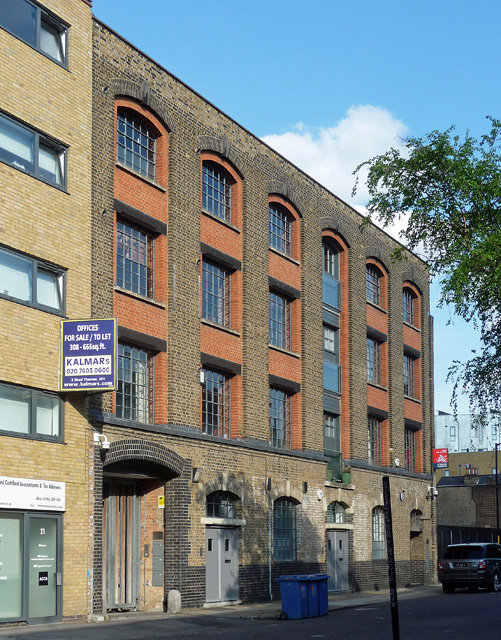
23–25 Blue Anchor Lane, former Victorian warehouse
23–25 Blue Anchor Lane — surviving Victorian warehouse, now converted
Stephen Richards · CC BY-SA 2.0
Today
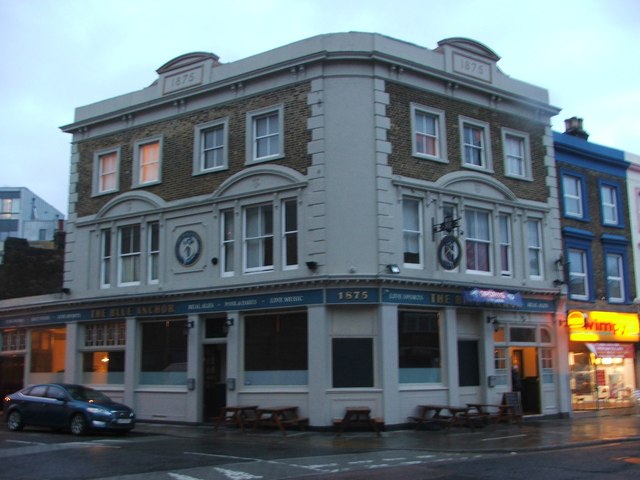
The Blue Anchor pub, Bermondsey
The Blue Anchor pub — the building that gave the lane its name, still on its original corner
Chris Whippet · CC BY-SA 2.0
✦   ✦   ✦
Name Origin

The “Blew Anchor” and Its Pilgrims

The name flows directly from the Blue Anchor tavern, which stood at the corner where the lane meets what is now Southwark Park Road. The earliest cartographic evidence places it here: Blue Bermondsey notes that the present pub building replaced earlier incarnations of “the Blew Anchor” as shown on the first surviving map of the area, dating to c. 1695. Edward Walford’s 1878 survey of London confirmed the etymology directly, describing Blue Anchor Road as “so named from a tavern bearing that sign, at the corner of Blue Anchor Lane.”

Some historians suggest that the “anchor” element may carry older religious resonance. The land here belonged to the monks of Bermondsey Abbey, founded in the 1080s. The route now called Southwark Park Road was a well-trodden path for pilgrims heading to Canterbury, and “anchorite” — a solitary religious hermit who dispensed counsel to travellers — shares its root with the word “anchor.” Whether the tavern sign was a nautical anchor or an allusion to spiritual anchorage remains uncertain, though the pub sign interpretation is the more commonly accepted reading. The colour blue, sacred in many religious traditions, may also reflect the land’s monastic associations.

How the name evolved
c. 1695 Blew Anchor (tavern)
mid-18th c. Blue Anchor Road
c. 1871 Blue Anchor Road / Lane
present Blue Anchor Lane
✦   ✦   ✦
History

From Pilgrim Route to Industrial Crucible

For most of its pre-industrial life, Blue Anchor Lane was little more than a country track across Bermondsey marshland. British History Online’s Victoria County History records that the wider road was “called Blue Anchor Road in the middle of the 18th century and in 1871,” when buildings were still crowded only to the north, with grazing fields stretching outwards. An 1802 newspaper report already described “a Mr Spencer passing Blue Anchor Lane, Bermondsey” when he was robbed and beaten by footpads and left in a ditch — a vivid reminder that the lane was then still semi-rural and poorly lit.

Key Dates
c. 1695
First Record
Earliest recorded reference to the “Blew Anchor” tavern, on the first surviving map of the Bermondsey area.
1789
First Landlord
Sun Fire Office records Thomas Griffiths as victualler of the Blue Anchor — the earliest licensed landlord in the documentary record.
1802
Dark Lane
First press mention of the lane: a violent robbery reported on Blue Anchor Lane, suggesting it remained an unlit rural track.
1813
The Cannery
Donkin, Hall & Gamble establish the world’s first commercial canning factory on Blue Anchor Road, supplying the Royal Navy.
1836
First Railway
Spa Road station opens as London’s first railway terminus, on the viaduct immediately north of the lane.
1878
New Pub
The current Blue Anchor building is erected on the corner of the lane, replacing the earlier tavern on the same site.
1947
The Collision
A steam train collides with an electric train in heavy fog on the viaduct above Blue Anchor Lane; one injury reported.

The pivotal transformation came in the early nineteenth century, when engineer Bryan Donkin established a papermaking factory on what was then open land along Blue Anchor Road in 1802. By 1813, Donkin and his partners had launched a canning operation on the same road — the world’s first commercial cannery, supplying the Royal Navy and endorsed in writing by King George III. The factory later merged into the Crosse & Blackwell empire; its footprint is now occupied by the Harris Academy school on Southwark Park Road, where a commemorative plaque still survives.

The railway arrived next. Spa Road station — the original if brief terminus of the London and Greenwich Railway — opened on 8 February 1836, its platforms perched on the new brick viaduct that still straddles the northern end of Blue Anchor Lane. The viaduct changed the lane’s character permanently, creating the dark arched passage that defines the street to this day. The wider road was renamed Southwark Park Road in the late nineteenth century, but the lane itself retained the “Blue Anchor” designation, anchored to the tavern still standing on the corner.

✦   ✦   ✦
Street Origin Products

Your listing has a better story than it’s telling

Blue Anchor Lane sits at the intersection of three centuries of industrial firsts, pilgrimage routes, and railway history. Here’s how to put that to work — and why it converts.

Professional Edition
Street Pack
“Why this address matters.”

Buyers pay more for addresses with a story. The Street Pack gives estate agents and developers brochure-ready copy, prestige framing and a name origin panel — everything needed to make this address feel significant before a viewing is booked.

  • Brochure copy — 100 & 200 word versions
  • Prestige framing version
  • Name origin panel
  • Timeline strip
  • Buyer persona framing
For estate agents, developers & property portals
From £19
Get the Street Pack
Street Social Kit
“Why this place feels interesting.”

Airbnb guests choose atmosphere as much as amenities. The Social Kit gives you five ready-to-post tiles, story templates, captions, hooks and a Reel script — all built from this street’s actual history. Done for you, in minutes.

  • 5 ready-to-post social tiles
  • 3 Story templates
  • 5 captions & 3 hooks
  • 1 Reel script
  • Hashtag clusters
For Airbnb hosts, boutique landlords & small agents
From £9
Get the Social Kit
✦   ✦   ✦
Culture

The Blue, Pie & Mash, and the Bermondsey Spirit

Blue Anchor Lane is the physical spine of “The Blue,” Bermondsey’s historic street market district centred on Southwark Park Road. At its peak the market boasted more than 200 stalls; residents recalled that you could buy “anything” down the Blue, with goods from the nearby factories flowing into the stalls by fair means and foul. The market moved to a purpose-built market place in 1976, but the cultural memory of the Blue as Bermondsey’s town centre endures. Pie and mash — a quintessential south-east London food — remains on offer at nearby traders, continuing a street-food tradition stretching back to the Victorian market’s heyday.

Railway Heritage
The Ghost of Spa Road Station

Where Blue Anchor Lane meets St James’s Road, the Victorian viaduct carries a remarkable relic. Tucked into the arches to the north-west are the bricked-up remnants of Spa Road station — London’s very first railway terminus, opened 8 February 1836 for the London and Greenwich Railway. The faint inscription “BOOKING OFFICE” above one arch is among the last visible traces of the station, which closed in 1915 and was never reopened.

The area has also been a cultural flashpoint. The lane and its surroundings appear in a 1928 London County Council photographic survey documenting slum conditions ahead of clearance — images that capture costermongers and children in threadbare coats amid timber-clad houses since demolished. That working-class Bermondsey identity persists today, expressed most visibly in the Millwall Football Club memorabilia that lines the walls of the Blue Anchor pub — a reminder that the football ground at The Den is only minutes away, and that match days transform the lane and its corner pub into something altogether louder.

Named after a tavern bearing that sign at the corner of Blue Anchor Lane… it forms the boundary between Bermondsey and Rotherhithe.
Edward Walford, Old and New London, Vol. 6 (1878), via British History Online
✦   ✦   ✦
People

The Engineer Who Fed the Navy

No individual is more closely associated with this stretch of Bermondsey than Bryan Donkin (1768–1855). The Northumbrian engineer arrived on Blue Anchor Road in 1802 to establish a papermaking machine factory on what were then open fields. By 1813, working with partners Hall and Gamble, he had turned the same site into the world’s first commercial canning factory. His preserved foods received a written endorsement from King George III, and by 1818 the operation was supplying the Royal Navy with over 20,000 cans of meat, soup, and vegetables per year. Donkin’s career was documented extensively in his personal diaries, now held at Derbyshire Records Office, and a commemorative plaque marks the school car park on Southwark Park Road where the factory once stood.

The wider neighbourhood around the lane also brushed against tragedy. In August 1872, a murder took place on Blue Anchor Lane itself when a local barber named James Daniel Rogers attacked his wife after a family outing to Victoria Park. The resulting trial at the Old Bailey returned a verdict of not guilty on grounds of insanity — a case that drew wide press coverage and reflected the Victorian legal uncertainty around such defences. Rogers was incarcerated regardless. Neither man is commemorated on the street, but both belong to the unvarnished social record of what was, in the nineteenth century, a rough-edged working district.

✦   ✦   ✦
Recent Times

Regeneration Beneath the Arches

The late twentieth century was hard on The Blue. The opening of Surrey Quays Shopping Centre in 1988 drew footfall away from Southwark Park Road, and by the 2000s the market and its surrounding streets had contracted sharply. A 2005 Metropolitan Police report singled out the area as a hotspot for antisocial behaviour — a label that stuck in media coverage for years and contributed to the district’s difficult reputation. In October 2014, The Blue became a Business Improvement District, the first formal mechanism for collective investment in the area’s public realm.

More recently, a £2 million investment from the Mayor of London’s Good Growth Fund has brought new market infrastructure, a public events space, and a new clock tower to the market square off Southwark Park Road. Southwark Council’s street improvement works have targeted Blue Anchor Lane itself, adding footway widening, cycle parking, benches, and a new pedestrian crossing at St James’s Road — converting the lane’s entrance from a vehicle rat-run into a pocket park. Coverage of these changes has been tracked by SE1 Direct, the Southwark community news resource that has followed the area’s regeneration closely.

Did You Know?

The commemorative plaque for the world’s first canning factory — honouring Bryan Donkin FRS and John Gamble’s 1813 operation on Blue Anchor Road — survives on the old schoolkeeper’s house at what is now the Harris Academy, Southwark Park Road. When you open a tin of baked beans, this lane is part of that story.

✦   ✦   ✦
Today

Under the Arches, Into the Present

Walking Blue Anchor Lane today means walking in shadow — the Victorian viaduct dominates the northern half of the street, its arches now occupied by small businesses and workshops. The southern portion opens out towards a low-rise residential mix of converted social housing and newer flats. The Blue Anchor pub stands on the corner of Southwark Park Road, its Victorian brick frontage largely intact and its interior unchanged in spirit: live sport, Millwall shirts, two cask ales. The lane’s new pocket park at the St James’s Road junction softens what was previously a bleak traffic pinch-point. Archaeology beneath Bermondsey’s streets continues to yield medieval and post-medieval finds; excavation reports by MOLA (Museum of London Archaeology), whose research into the wider Bermondsey area extends to the Cluniac priory and abbey, underpin the historical record for this part of south London.

The nearest green spaces provide essential breathing room in a densely built neighbourhood. Historic England’s records for the broader Bermondsey conservation area recognise the heritage value of the Victorian streetscape that frames the lane, including the listed railway viaduct and the surviving pub building.

10 min walk
Southwark Park
A 63-acre Victorian park with a boating lake, galleries, bandstand (dating from 1884), and the Ada Salter rose garden. Bermondsey Carnival fills it each June.
8 min walk
Bermondsey Spa Gardens
A quiet pocket park on Grange Walk, close to the site of the medieval Bermondsey Abbey. Popular with families and workers on lunch breaks.
12 min walk
King’s Stairs Gardens
A riverside green space on the Thames at Bermondsey, managed by the Friends of Southwark Park. Offers direct views across to Wapping.
15 min walk
Leathermarket Gardens
A hidden garden within the old leather trade quarter off Bermondsey Street, with the Shard visible above the rooftops.
✦   ✦   ✦
On the Map

Blue Anchor Lane Then & Now

National Library of Scotland — Ordnance Survey 6-inch, c. 1888. Hosted by MapTiler. Modern: © OpenStreetMap contributors.

✦   ✦   ✦

Frequently Asked Questions

Why is it called Blue Anchor Lane?
Blue Anchor Lane takes its name from the Blue Anchor tavern that stood at the corner of the lane and what is now Southwark Park Road. The pub appears as the “Blew Anchor” on the earliest map of the area, dated c. 1695. Edward Walford’s 1878 survey of London confirmed it directly, describing the wider Blue Anchor Road as named “from a tavern bearing that sign, at the corner of Blue Anchor Lane.” The wider road has since been renamed Southwark Park Road, but the lane itself retains the original pub name.
Was the world’s first canning factory near Blue Anchor Lane?
Yes. In 1813, engineer Bryan Donkin and his partners Hall and Gamble established what is widely regarded as the world’s first commercial canning factory on Blue Anchor Road, Bermondsey — the wider road of which Blue Anchor Lane is an offshoot. The factory supplied canned food to the Royal Navy, and the preserved veal was endorsed by King George III. The site is now occupied by the Harris Academy school on Southwark Park Road, where a commemorative plaque survives on the old schoolkeeper’s house.
What is Blue Anchor Lane known for?
Blue Anchor Lane is the short Bermondsey side street that — via its ancient tavern — gave its name to the whole “Blue” district, historically Bermondsey’s market quarter centred on Southwark Park Road. The lane runs beneath the Victorian Brighton Main Line viaduct, and its northern junction at St James’s Road sits yards from the bricked-up remnants of Spa Road station, London’s first railway terminus, which opened in February 1836. It is also adjacent to the site of Bryan Donkin’s pioneering 1813 cannery.