Explore London England Scotland Wales About API
Southwark · SE1

Bear Gardens

A cobbled lane named after Elizabethan blood sport—where thousands gathered to watch chained bears battle dogs, before the arena was replaced by London’s last great playhouse.

Name Meaning
Bear-Baiting Arena
First Recorded
c. 1546
Borough
Southwark
Last Updated
Time Walk

Theatre and Torment Side by Side

Bear Gardens is a narrow, tightly cobbled lane running south from Bankside to Park Street, tucked away in the shadow of the modern Southbank Centre. To walk it now is to see only warehouse conversions and Georgian terraces—but beneath your feet lies the memory of one of Tudor London’s most notorious entertainments. According to British History Online, this small square marks approximately the site of the last bear-baiting ring, and the alley’s name itself is all that survives of the roaring arenas.

2008
Bear Gardens
Bear Gardens
Wikimedia Commons · CC BY-SA 2.0
2012
The Bear Garden, Bankside, London
Wikimedia Commons · Public domain
2014
Bear Gardens, Southwark
Wikimedia Commons · CC BY-SA 2.0
Today
International Shakespeare Globe Centre, London SE1 — near Bear Gardens
Geograph · CC BY-SA 2.0

For over two centuries, this corner of Bankside was ruled by bears—chained to posts while mastiffs tore at them, watched by crowds that spanned from servants to ambassadors. MOLA excavations have uncovered the buried remains of at least three of these arenas. The street’s name is a phantom—it commemorates a place that was never peaceful, and an entertainment that seems almost incomprehensible today.

✦   ✦   ✦
Name Origin

The Beast That Named a Street

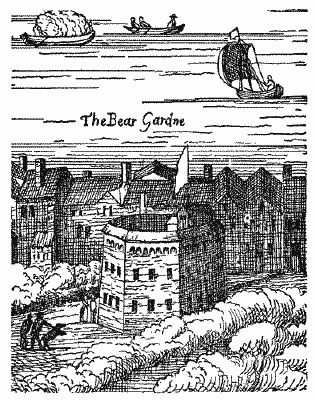
The Bear Garden was a facility for bear-baiting, bull-baiting, and other “animal sports” in the London area during the 16th and 17th centuries. The Beargarden was in existence by the 1560s, when it is shown on the “woodcut” map of the city, though the first specific reference to bear-baiting on Bankside is in an order of Henry VIII dated 13 April 1546. The facility itself was never a garden but a polygonal wooden arena—a donut-shaped structure not unlike the theatres nearby, with tiered galleries surrounding a central arena where bears were chained to posts.

By the 17th century the general area including the arenas, kennels and adjoining houses had become known as Bear Gardens, a street name which survives today on Bankside. The name merged location and function so completely that it outlasted the blood sport itself by centuries. The alley that runs today between Bankside and Park Street preserves a memory of violence—a street named after an arena where the screams of bears and the roar of crowds once filled the Elizabethan air.

How the name evolved
c. 1546–1620 The Bear Garden
1620 onwards Bear Gardens
present Bear Gardens
✦   ✦   ✦
History

From Royal Licence to Commonwealth Closure

In 1573 a Ralph Bowes was appointed Queen Elizabeth’s “Master of Her Majesty’s Game at Paris Garden”. Elizabeth herself, like other royals and aristocrats of her era, was a passionate fan of animal baiting. The Bear Garden was not a marginal entertainment; it was patronised by the Crown, visited by foreign dignitaries, and attended by perhaps a thousand spectators at a time, who paid between one and three pence per visit—the same cost as a ticket to the Globe Theatre.

Key Dates
1546
Royal Licence Granted
Thomas Fluddie, Yeoman of the King’s Bears, licensed to conduct bear-baiting on Bankside, beginning a two-century tradition.
1583 Jan
Scaffold Collapse
Eight people killed when tiered seating collapsed during an event; Puritan commentators attributed the disaster to God’s displeasure at the sport.
1604
Henslowe & Alleyn Take Control
Theatre owner Philip Henslowe and actor Edward Alleyn purchase the royal office of Master of the Bears for £450, uniting playhouse and baiting-pit ownership.
1613
The Hope Theatre Built
Henslowe and partner Jacob Meade tear down the Bear Garden and replace it with the Hope, designed as a dual-purpose playhouse and baiting arena.
1656
Bears Shot, Arena Demolished
During the Commonwealth, Colonel Thomas Pride orders the last surviving bears shot and dismantles the Hope Theatre, ending two centuries of baiting.
Did You Know?

One bear, Sackerson, achieved such celebrity status that Shakespeare references it by name in The Merry Wives of Windsor. Named bears like Tom Hunckes and Blind Bess were crowd favourites—valuable enough to be rarely killed, unlike the expendable mastiffs that fought them.

In 1604, Philip Henslowe and his son-in-law Edward Alleyn purchased the royal office of the Mastership for £450. Henslowe bought out Alleyn’s share in 1611, for £580 (though Alleyn re-acquired his share upon Henslowe’s 1616 death). In 1613, Henslowe and new partner Jacob Meade tore down the Beargarden, and in 1614 replaced it with the Hope Theatre. The Hope was unique: Archaeological excavations revealed a polygonal building with ten sides, with an internal diameter of 16m and external diameter of 24m. The general construction is consistent with the excavated remains of The Globe Theatre. The first play staged there was Ben Jonson’s ‘Bartholomew Fair’.

Yet the Hope was never truly a theatre. At a somewhat later date plays were performed on Mondays, Wednesdays, Fridays and Saturdays, and the bears were baited on Tuesdays and Thursdays. By the 1620s, bear-baiting was the dominant use. The Council of State ordered in 1653 that ’the bear baiting, bull baiting and playing for prizes by fencers hitherto practised in Southwark’ and elsewhere should cease. In 1655 a company of soldiers shot seven of the bears to death by command of Thomas Pride, and in the next year Thomas Walker, then lord of the Clink, pulled down the playhouse and built tenements on its site. At the Restoration, however, the Bear Garden was reinstated in its old place—but the era of public spectacle was over.

Street Origin Products

Your listing has a better story than it’s telling

Bear Gardens sits on the heart of Elizabethan Bankside, where bear-baiting drew crowds for two centuries. Here’s how to put that history to work.

Professional Edition
Street Pack
“Why this address matters.”

Buyers pay more for addresses with a story. The Street Pack gives estate agents and developers brochure-ready copy, prestige framing and a name origin panel—everything needed to make this address feel significant before a viewing is booked.

  • Brochure copy — 100 & 200 word versions
  • Prestige framing version
  • Name origin panel
  • Timeline strip
  • Buyer persona framing
For estate agents, developers & property portals
From £19
Get the Street Pack
Street Social Kit
“Why this place feels interesting.”

Airbnb guests choose atmosphere as much as amenities. The Social Kit gives you five ready-to-post tiles, story templates, captions, hooks and a Reel script—all built from this street’s actual history.

  • 5 ready-to-post social tiles
  • 3 Story templates
  • 5 captions & 3 hooks
  • 1 Reel script
  • Hashtag clusters
For Airbnb hosts, boutique landlords & small agents
From £9
Get the Social Kit
✦   ✦   ✦
Culture

Theatre and Torture in One Building

Bear Gardens sits at the heart of what was London’s most intensely theatrical quarter. Within a few hundred yards of this alley stood the Globe, the Rose, the Swan, and the Hope—plus the Bear Garden itself, which was as much a spectacle-machine as any playhouse. The Globe and The Rose Theatre were built alongside the bear-baiting arenas and attracted the same audiences. In 1591 an anonymous complainant requested theatre to be restricted as it was harming the bear-baiting business. Both were commercial entertainments competing for pennies. Both drew royalty and groundlings alike.

Next to the cleaned-up warehouse is a recessed building, a Georgian warehouse, that was once The Bear Gardens Museum of the Shakespearean Stage, which illustrated the history of the area’s playhouses and theatres between 1972 and 1994. The museum is important locally, as it’s also where Sam Wanamaker’s project to build a replica of Shakespeare’s Globe was run from. That a museum dedicated to the Globe Theatre was once housed here—on the very site of the old arena—speaks to how thoroughly Bankside entertainment has been forgotten, then recovered, then memorialised.

✦   ✦   ✦
On the Map

Bear Gardens Then & Now

National Library of Scotland — Ordnance Survey 6-inch, c. 1888. Hosted by MapTiler. Modern: © OpenStreetMap contributors.

✦   ✦   ✦

Frequently Asked Questions

Why is it called Bear Gardens?
The street is named after the Bear Garden, a polygonal bear-baiting arena that stood on Bankside from at least the 1560s. The facility hosted animal sports until it was demolished in 1613 to make way for the Hope Theatre. By the 17th century, the entire area including arenas, kennels and adjoining houses had become known as Bear Gardens, a name that survived as a street.
When did bear-baiting take place in Southwark?
Bear-baiting on Bankside is documented from at least 1546, when a royal licence was granted. The sport was at its height during the Elizabethan era (16th century) and remained popular through the 17th century. It was suppressed during the Commonwealth in the 1650s but revived at the Restoration in 1660 before finally being banned in 1835.
What is Bear Gardens known for?
Bear Gardens is known as a narrow cobbled lane on Bankside that preserves the memory of Elizabethan entertainment culture. The street once occupied the heart of London’s famous bear-baiting district, where thousands gathered to watch bears and bulls attacked by dogs. Today it’s one of the few tangible reminders of Tudor entertainment that sat in the shadow of Shakespeare’s Globe Theatre.